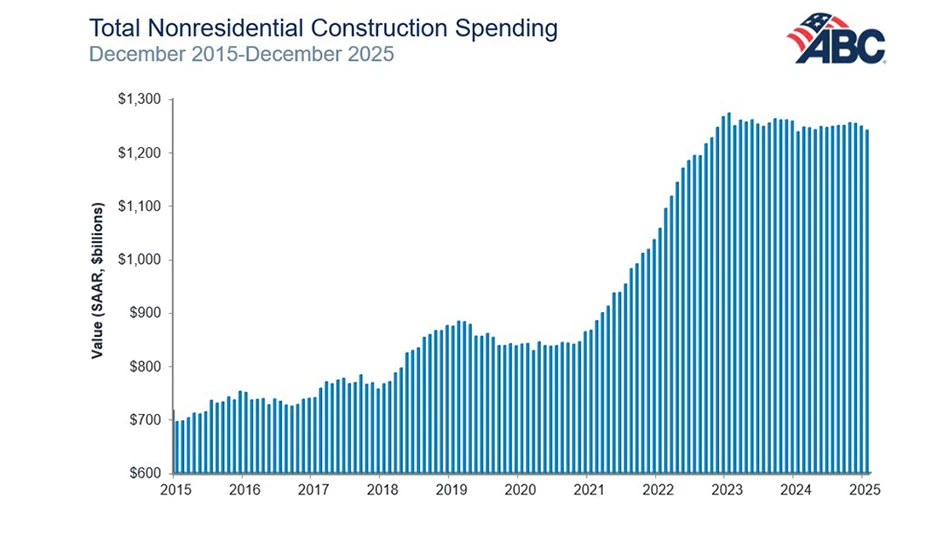
Construction employment grew in 255 of 358 metro areas, or 71 percent, between July 2018 and July 2019, according to a recent analysis of federal employment data by the Associated General Contractors of America (AGC). Meanwhile, construction employment declined in 56 metro areas and was unchanged in 47.
Association officials say a newly released workforce survey they conducted with Autodesk showed the employment gains would likely have been even more widespread if firms could find more qualified workers to hire, and they urged federal officials to bolster career training programs.
“Demand for construction has not slackened in most metro areas,” says Ken Simonson, the association’s chief economist. “In fact, of the nearly 2,000 respondents to our survey—91 percent— said they expect their firm to hire hourly craft personnel in the next 12 months, either for expansion or replacement. But four out of five contractors reported having a hard time filling hourly craft positions.
“Worker shortages are pervasive across all regions and nearly all crafts. The survey asked firms about their experience this year in filling 20 different types of hourly craft positions. For all but one of these trades, at least half the respondents said filling the position is more difficult than a year ago. Firms in all four regions—Northeast, Midwest, South and West—reported widespread difficulty filling craft positions.”
The Los Angeles-Long Beach-Glendale, California, metro area added the most construction jobs during the past year (12,100 jobs, 8 percent), followed by Phoenix-Mesa-Scottsdale, Arizona (11,900 jobs, 9 percent). The largest percentage gain occurred in Spokane-Spokane Valley, Washington (23 percent, 3,500 jobs), followed by Auburn-Opelika, Alaska (19 percent, 500 jobs).
The largest job losses between July 2018 and July 2019 occurred in Baton Rouge, Louisiana (-4,900 jobs, -9 percent), followed by Charlotte-Concord-Gastonia in the Carolinas (-3,100 jobs, -5 percent). The largest percentage decrease took place in Watertown-Fort Drum, New York (-10 percent, -200 jobs).
One of the biggest challenges facing many construction firms is the lack of available, qualified workers to hire, AGC says. The survey found that 45 percent of respondents give a rating of “poor” to the adequacy of the local pipeline for supplying craft personnel who are well-trained or skilled.
Association officials say part of the problem is that the nation’s higher education system does not place career and technical education on an equal footing with traditional college education. For example, federal Pell grants cannot be used for construction-focused training programs offered by community and technical colleges. Stephen E. Sandherr, the association’s chief executive officer, called on Congress and the administration to pass the bipartisan JOBS Act, which would remedy this Pell grant problem.
“It’s high time to end the federal funding bias against career and technical education and provide students interested in vocational education with the same opportunities available to students attending four-year colleges,” Sandherr says in a news release. “Leveling this playing field will help introduce more young adults to the many high-paying opportunities throughout the construction industry.”
Latest from Construction & Demolition Recycling
- Vecoplan to present modular solutions at IFAT 2026
- Terex Ecotec appoints Bradley Equipment as Texas distributor
- Greenwave raises revenue but loses money in Q2 2025
- Recycled steel prices hold steady
- John Deere launches ‘Building America’ excavator contest
- Triumvirate Environmental acquires Environmental Waste Minimization
- Coastal Waste & Recycling expands recycling operations with Machinex
- Reconomy acquires German-based GfAW