B&B Wrecking and Excavating is a full-service demolition company based in Cleveland. Since 1957, the family-owned business has performed industrial, commercial and residential demolition, as well as dismantlement, interior strip-outs and environmental remediation.
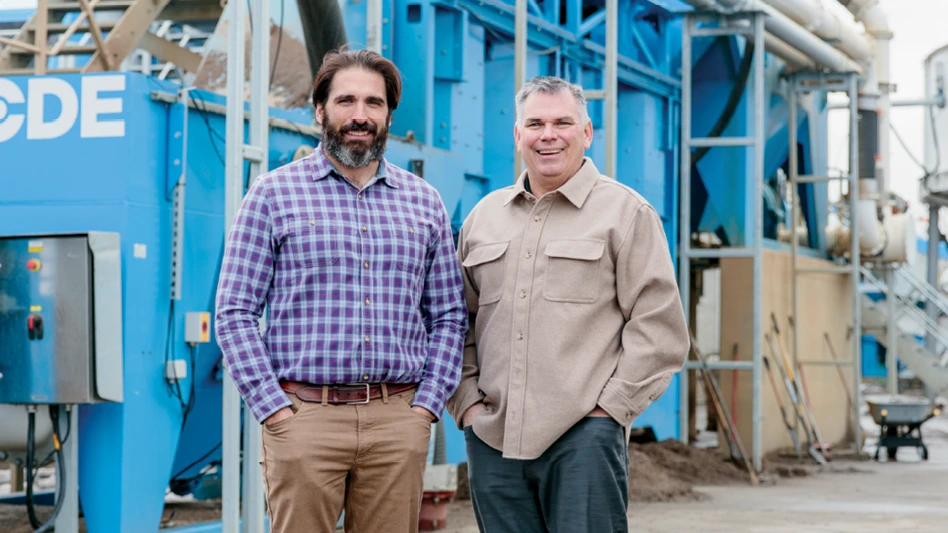
Brian Baumann began working at B&B Wrecking and Excavating with his father over summers and holiday breaks from school when he was 14 years old. After graduating from college at age 22, he began with the company full-time, becoming president of B&B Wrecking at age 25.
With about 250 employees, B&B Wrecking covers all of Ohio and its surrounding states and frequently uses breakers and processors.
Dealer support
Baumann says the company frequently works with equipment dealer Company Wrench, headquartered in Carroll, Ohio. This relationship led the company to begin using LaBounty, Komatsu and Kobelco excavators, though it uses Caterpillar and Volvo equipment, as well.
B&B Wrecking has 20-25 processors and hammers, including skid-steer-mounted hammers, LaBounty processors and two or three Genesis multitool attachments.
When picking out breakers, he says the company looks for two main features: parts availability and dealer support.
“Unfortunately, in the demolition industry, we are going to break whatever it is. ... At some point, we’re going to need support,” he says. “So, we like to go with brands that are represented by good dealers.”
While the product itself matters, dealer support is an important factor in selecting a supplier. If someone has a great hammer but can’t get a part for a week or two, its value decreases, Baumann explains.
“Typically, when you’re using a hammer or processor, the reason you’re using it is because you have to be. ... It’s important,” he says. “And those that don’t have a lot of [spare parts], you either have to move another machine there or rent something, and that becomes very cost-prohibitive, and it hurts the job.”
Training operators
When it comes to pairing a breaker with a carrier, Baumann advises contractors to make sure the machine is plumbed properly and confirm that the pressures are set to factory specifications, especially when using hammers and processors.
B&B Wrecking also recommends training each operator who’s going to be running the hammer, ensuring it is not cycled for more than 30 seconds and that the equipment is greased properly.
If the tool auto-greases, the operator needs to assure the grease is filled, he says. “We’ve had some issues where an operator says, ‘Well, it’s an auto greaser.’ Well, yeah, but you still have to put grease in the auto-greaser.”
Baumann is a fan of the auto-greaser, and the company has the feature on many of its hammers. He says that while hammers with this feature cost a little bit more up front, they are worthwhile and a good investment.
Choosing the right attachment
Certain tasks require different attachments and carriers. Baumann says the biggest factor when selecting the right pairing is the height of the structure.
Whether it’s a one-, two- or three-story structure matters when selecting the combination because the processor is paired with the carrier, which determines what it can reach.
Another important decision when choosing an attachment relates to the opening of the processor’s jaw.
“If you’ve got a 12-inch floor, you don’t want to be using a processor that is, at its max, 12 inches,” he explains. “You want to be, probably at 3:1, if possible. If you’ve got a 12-inch-thick concrete floor, you want a processor that can process concrete up to 36 inches.”
At B&B Wrecking, that ratio is sometimes not possible when the company gets into processing thicker foundations. Ideally, operators aim for at least a 2:1 ratio.

Avoiding expensive equipment mistakes
Contractors often can face significant equipment costs.
To keep these expenses under control, Baumann recommends contractors make sure the equipment operator has the right size tool for the task at hand.
It’s also helpful for the equipment’s longevity if the operator is trained in how to properly demolish or deconstruct a structure, whether it’s concrete, steel or brick.
Baumann also advises keeping an eye on wear parts. “A lot of the processors have replaceable teeth. Once the teeth need turning or processing, make sure you do that. Don’t wait until you break a tooth.”
He says this can be a big problem. Not only will the teeth need to be replaced, but the tool itself will need to be built up.
With hammers, Baumann recommends the same steps to avoid additional costs: make sure it’s getting the proper grease and ensure that the operator is trained on proper use.
Proper use
To maintain breakers and processors, Baumann says a lot of it is common sense, but it’s also important to inspect the equipment each day and manage the operator to make sure it's being used properly.
“You need to make sure that you’re building up the teeth sometimes, making sure they’ve got welding,” he says. “Making sure when they’re ready to be flipped, you’re flipping them again.”
With hammers, it’s important to train the operator not to pry with the bit as Baumann says that’s the best way to break a bit.
“We had a situation [recently] where we had a hammer operator who was … [using] the hammer as a hammer rather than using the hydraulics,” he says. “So, we had to fire him because he just wouldn’t listen.”
Baumann adds, “It’s very rare that if you use a hammer properly, you break a bit. You break the bit when you hammer with the machine and then you start prying with it.”
Ensuring smooth operations when using these attachments, he says, goes back to proper training.
“Processors process; hammers hammer,” he says. “So, don’t do the opposite of that. Just because you can get a structure down faster by taking the processor and whacking the concrete, it doesn’t mean that that’s the right way to do it.”
Having supervisors on-site to confirm that operators are using the tools properly for their intended purposes also can go a long way to ensuring their longevity and productivity, Baumann adds.
See something, say something
B&B Wrecking is a safety-oriented company, providing site prep work to ensure the safety of its employees and anyone else at or near a jobsite.
The company has weekly toolbox talks and a full-time safety officer who conducts weekly foreman meetings and gives instructions on what to work on.
When hired, employees complete a safety orientation.
If there are more than 25 employees on a jobsite, Baumann says a full-time safety professional is assigned to that job to constantly monitor safety.
“But it’s not just the safety person’s job,” he says. “Safety is everyone’s job: the superintendent, the foreman [and] each individual worker.
“Everybody has stop work authority on our jobsites; if they see something wrong, they’re supposed to say something.”
Explore the March/April 2026 Issue
Check out more from this issue and find your next story to read.
Latest from Construction & Demolition Recycling
- Equipment finance index takes dip in March
- Nucor guidance points to profitable Q1
- Iron Bull introduces construction hoppers
- Sierra International Machinery adds to sales team
- Breedon Group to open two waste recovery and recycling sites
- Tariff criticism directed toward steel industry
- No dust ups
- On World Recycling Day, Allen Burns says C&D recycling progress depends on better data and sorting