"In the short-term, fewer firms will be able to bid on construction projects if they are concerned they will not have enough workers to meet demand," says Stephen Sandherr, AGC CEO. "Over the long-term, either construction firms will find a way to do more with fewer workers or public officials will take steps to encourage more people to pursue careers in construction."
Of the more than 1,600 survey respondents, 70 percent said they are having difficulty filling hourly craft positions, Sandherr notes. Craft worker shortages are the most severe in the West, where 75 percent of contractors are having a hard time filling those positions, followed by the Midwest where 72 percent are having a hard time finding craft workers, 70 percent in the South and 63 percent in the Northeast.
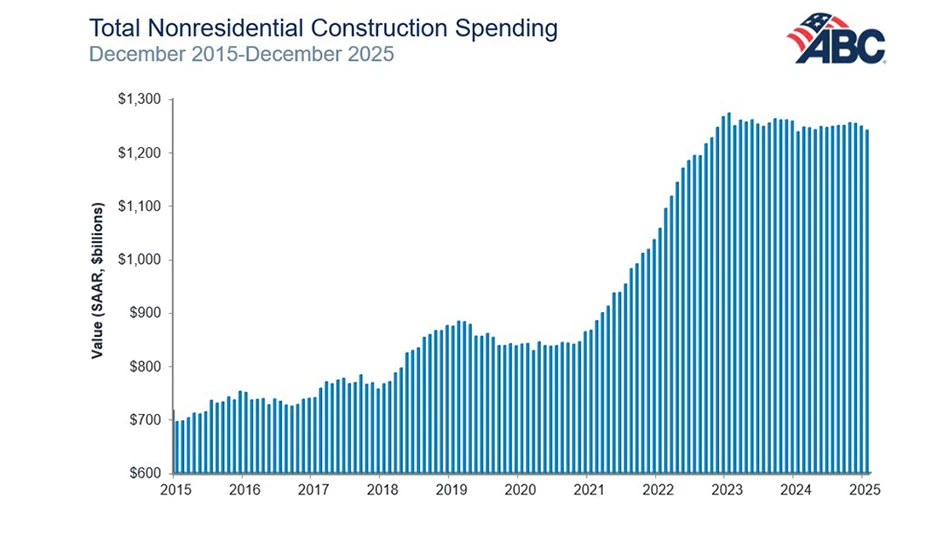
The labor shortages come as demand for construction continues to grow. Sandherr noted that construction employment expanded in 258 out of 358 metro areas that the association tracks between July 2016 and July 2017, according to a new analysis of federal construction employment data the association also released today. Growing demand for construction workers helps explain why 67 percent of firms report it will continue to be hard, or get harder, to find hourly craft workers this year.
Tight labor market conditions are prompting firms to change the way they operate, recruit and compensate workers, Sandherr notes. Most firms report they are making a special effort to recruit and retain veterans (79 percent); women (70 percent) and African Americans (64 percent). Meanwhile, half of construction firms report increasing base pay rates for craft workers because of the difficulty in filling positions. Twenty percent have improved employee benefits for craft workers and 24 percent report they are providing incentives and bonuses to attract workers.
Forty-six percent of firms also report they are doing more in-house training to cope with workforce shortages while 47 percent report they are increasing overtime hours and 41 percent are increasing their use of subcontractors. In addition, 22 percent report they are increasing their use of labor-saving equipment, 11 percent are using offsite prefabrication and 7 percent are using virtual construction methods like Building Information Modeling, or BIM for short.
"The ongoing labor drought continues to put pressure on the already high-risk, low-margin construction industry," says Sarah Hodges, director of the construction business line at Autodesk, a 3D design, engineering and construction software firm. "As labor challenges continue to grow, technology will play an increasingly important role supporting the existing workforce while inspiring the next generation of industry professionals."
Sandherr called on federal, state and local officials to act on the measures in the association's Workforce Development Plan to address the growing worker shortages. In particular, he urged the Senate to pass legislation to reform and increase funding for the Perkins Career and Technical Education Act.
The survey was conducted in July and early August. Click here to see the national survey results, analysis of the data and regional and state-by-state results.
Latest from Construction & Demolition Recycling
- Des Moines project utilizes recycled wind turbine blades
- Vecoplan to present modular solutions at IFAT 2026
- Terex Ecotec appoints Bradley Equipment as Texas distributor
- Greenwave raises revenue but loses money in Q2 2025
- Recycled steel prices hold steady
- John Deere launches ‘Building America’ excavator contest
- Triumvirate Environmental acquires Environmental Waste Minimization
- Coastal Waste & Recycling expands recycling operations with Machinex